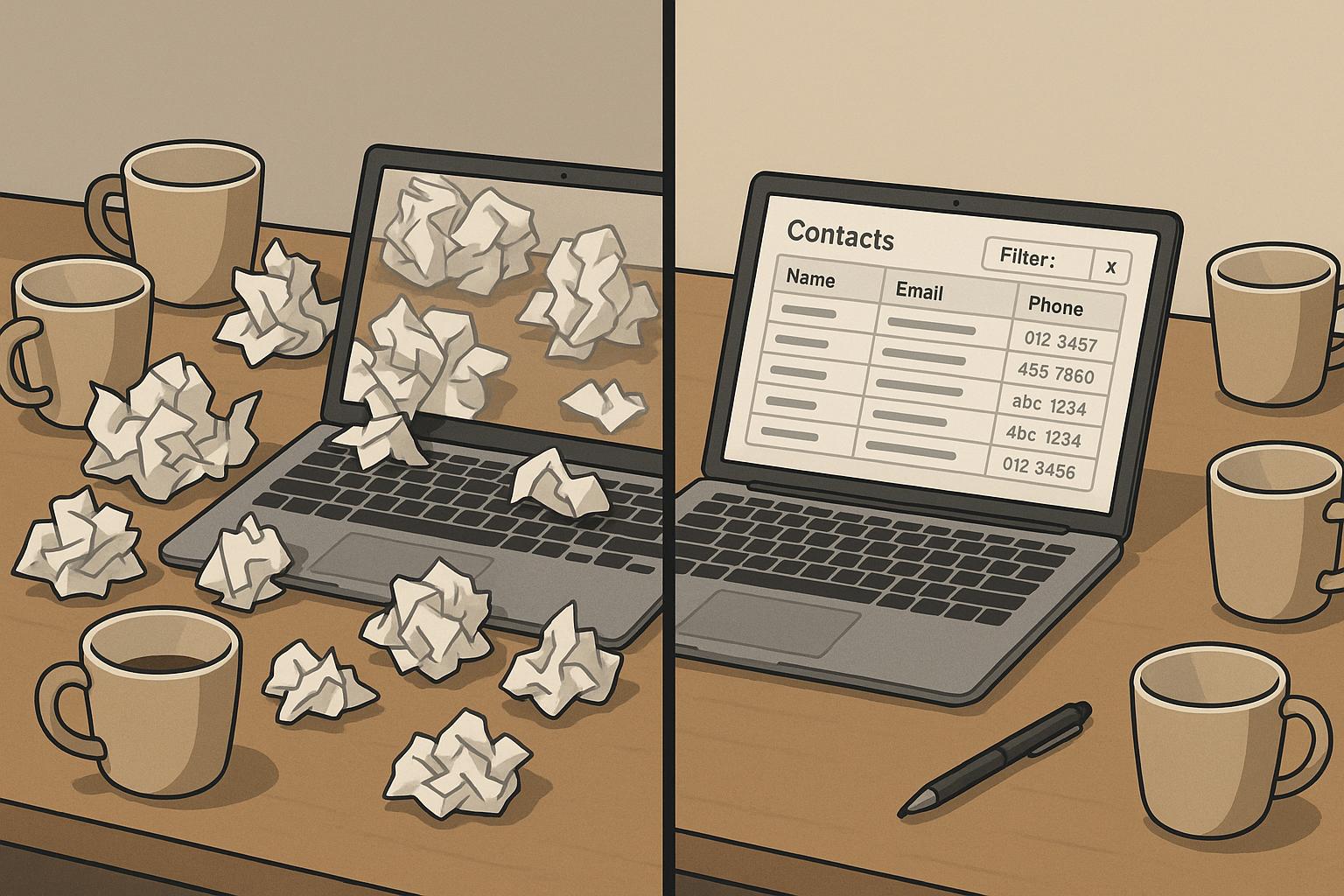
Sales teams today are losing productive hours to incorrect contact data at a scale that now threatens quota attainment and revenue growth. According to a PRSync announcement by nerDigital AI, pursuing bad leads can consume up to 27% of a sales team's time, with commercial email lists losing roughly 28% of contacts annually; that erosion turns promising prospect lists into rapidly depreciating assets and leaves sellers doing data cleanup rather than selling. [1]
Real-time data sourcing is presented as the antidote to this decay. According to the announcement, nerDigital AI's platform pulls contact details at the moment of search, cross-referencing live sources such as employee directories, press releases and social media to verify that email addresses, phone numbers and job titles reflect current reality rather than historical snapshots. The company claims this live verification boosts conversion rates two to three times compared with traditional, static databases. [1]
The limits of recycled database models are stark. The PRSync piece argues that static providers sell the same lists to many buyers, producing market saturation and identical outreach that conditions prospects to ignore approaches from multiple vendors. Industry commentary reinforces that stale data undermines decision-making and response times, and that reliance on outdated information slows adaptation to market shifts. According to SalesVista, using stale sales data leads to poor strategic choices and missed opportunities that directly impact performance and long-term sustainability. [1][2][6][7]
Speed matters. NerDigital AI highlights research showing that contacting prospects within five minutes makes sales teams 21 times more likely to qualify a lead than waiting 30 minutes or more,a stat the company uses to explain why fresh contact accuracy and instant outreach are complementary advantages. That emphasis on immediacy echoes broader market advice that real-time intelligence enables teams to act on buying signals before competitors can. [1][2]
AI-driven targeting and message personalisation are presented as crucial multipliers. The nerDigital announcement describes how feeding examples of successful customer profiles trains machine-learning models to prioritise likely buyers, and how automated personalisation crafts subject lines and opening paragraphs tailored to a prospect's role, recent company events and industry pain points. Independent reviews of AI lead tools note similar approaches: platforms that continuously scan the web and enrich records deliver higher reliability than one-off database purchases. SalesForge's product analysis, for example, highlights real-time refresh and verification as central differentiators for modern prospecting tools. [1][5]
Data enrichment is framed not as a one-off cosmetic update but as an ongoing maintenance function. NerDigital AI says live enrichment flags outdated records and supplies current details as changes occur, while integrations with CRMs automatically synchronise enriched profiles, scoring and engagement histories so sellers do not leave their workflow. External commentary supports that poor CRM data degrades morale and efficiency, SalesIntel reports salespeople can spend as much as a third of their day handling bad data and that 40% of B2B leads may be invalid, incomplete or duplicated, underscoring the operational lift required to sustain outbound activity without continuous enrichment. [1][3]
The argument culminates in measurable uplift. The PRSync announcement states companies using AI-powered lead generation report up to 50% more leads than those relying on traditional database methods,a gain attributed to fresher contact information, smarter scoring and automated prioritisation. That claim aligns with the broader industry trend toward platforms that blend live data, social listening and AI analysis to surface timely opportunities. Monitoring vendors that aggregate signals across social media and newsfeeds further illustrate how real-time listening complements contact verification to reveal intent and context. [1][4][5]
Taken together, the case made is that treating data as a living asset, maintained through live enrichment, AI-assisted profiling and CRM integration, delivers faster qualification, higher engagement and better use of sellers' time than cyclical list purchases. While the assertions come from a company announcement and should be read as vendor claims, independent industry analyses consistently warn that stale data reduces sales productivity and that continuous, real-time intelligence materially improves the odds of timely outreach and conversion. [1][2][3][5]
For sales and marketing leaders weighing options, the practical takeaway is twofold: reduce dependence on one-time database buys that age immediately,and adopt continuous enrichment and real-time sourcing to preserve the value of CRM records and accelerate outreach. The potential gains, a sharper focus for sellers, higher lead volumes and quicker qualification, depend on integration, data governance and whether AI models are trained on quality feedback from actual conversion outcomes. [1][2][3][5]
##Reference Map:
- [1] (PRSync / nerDigital AI press release) - Paragraph 1, Paragraph 2, Paragraph 4, Paragraph 5, Paragraph 7, Paragraph 8, Paragraph 9
- [2] (SalesVista) - Paragraph 3, Paragraph 8, Paragraph 9
- [3] (SalesIntel) - Paragraph 6, Paragraph 9
- [4] (Pulsar) - Paragraph 7
- [5] (SalesForge) - Paragraph 5, Paragraph 7, Paragraph 9
- [6] (SalesVista) - Paragraph 3
- [7] (SalesVista) - Paragraph 3
Source: Noah Wire Services