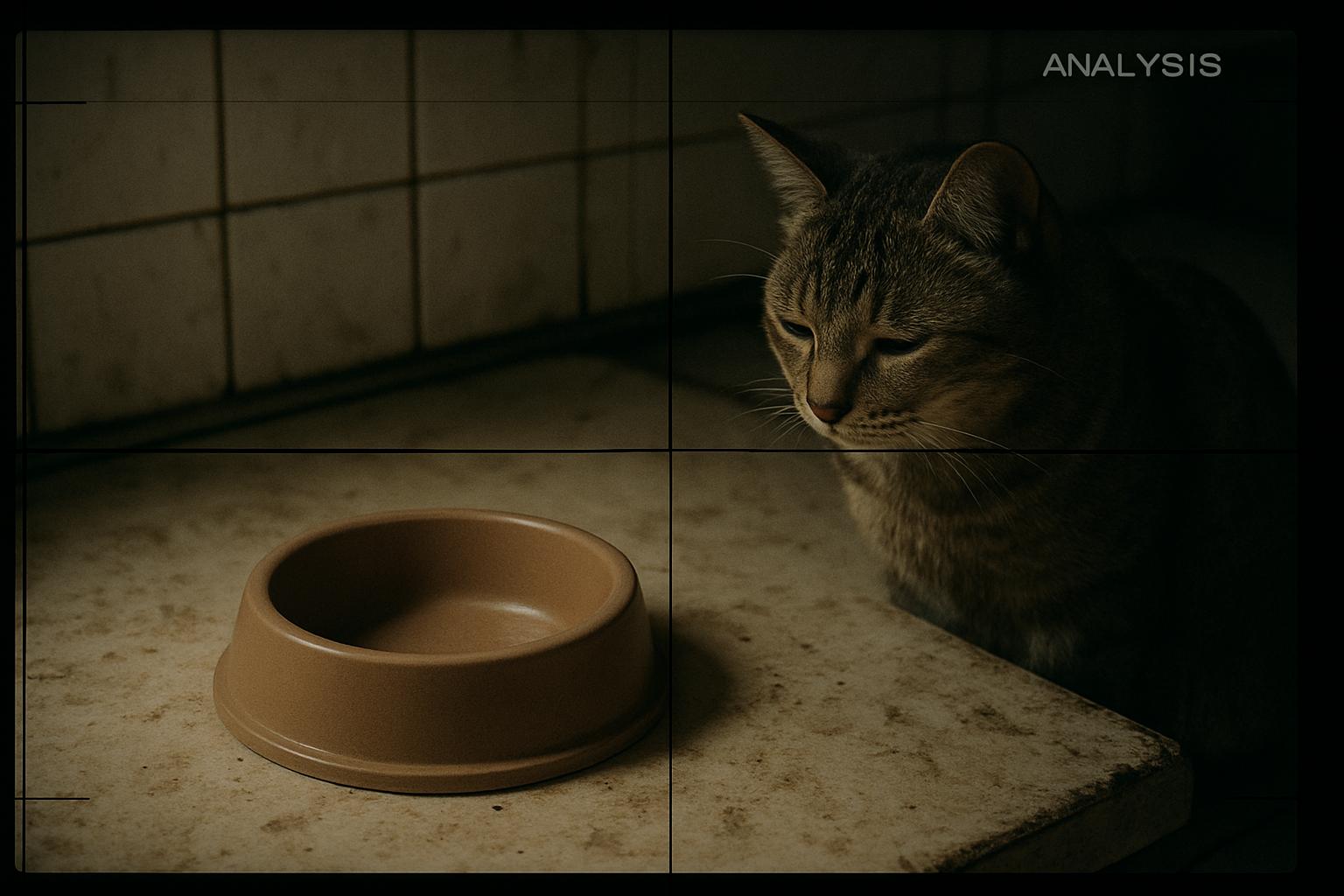
Artificial intelligence is illuminating everyday feline behaviour in ways that were previously the domain of lab-bound slow-motion cameras and academic papers. According to the report by Blockchain News, PicLumen AI is deploying computer vision and deep learning to analyse ordinary home video footage and infer how cats drink when their owners are not watching, translating milliseconds of tongue movement into actionable insights for product design and pet care. [2]
The platform identifies subtle kinematic patterns during lapping and uses those patterns to inform smarter water-dispensing hardware and personalised recommendations for owners, the company claims in the announcement covered by Blockchain News. This approach mirrors long-standing scientific interest in the mechanics of feline drinking , notably the 2010 Science study that described the delicate interplay of inertia and gravity in a cat's lap , but brings the methods out of the lab and into the home through automated, scalable video analysis. [1][Analysis]
Commercial applications are already proliferating across the pet-tech ecosystem. Industry offerings range from AI-enabled cameras that monitor behaviour and flag anomalies to generative tools that create educational or entertaining animal videos, as seen in products from firms such as Hailuo AI and Medeo which generate realistic slow-motion or stylised cat videos from prompts. According to coverage of these services, the same underlying models used for monitoring can be repurposed to produce content for creators and consumers, expanding monetisation pathways for pet-tech companies. [3][4][2]
Beyond consumer-facing cameras and content, veterinary and clinic software vendors are integrating AI into workflows, improving medication management, supply forecasting and triage through behaviour monitoring and predictive analytics, as outlined in industry analyses. Government and regulatory frameworks for health-related AI remain relevant where tools make clinical claims, so many vendors position features as "insights" rather than diagnoses while pursuing standards compliance. [5][Analysis]
Technically, the field draws on computer vision architectures such as convolutional neural networks and multimodal systems that combine visual with temporal cues; recent research into "agent-to-sim" frameworks shows how long-term, smartphone-captured recordings can be converted into interactive 4D behaviour simulators. Such advances improve model robustness to the variable lighting and camera angles typical of domestic settings and open paths to simulation-driven training datasets that reduce the need for costly manual labelling. Industry data shows edge-compute deployments and on-device inference are increasingly common to lower latency and limit cloud exposure of user data. [7][Analysis]
Market dynamics make the space attractive to both incumbents and startups. Reports cited in the wider analysis estimate substantial growth in pet wearables and smart-pet markets over the coming years, driven by rising pet ownership and subscription business models that bundle devices with analytics. Companies exploring blockchain-based data governance argue the technology can bolster transparency and privacy for pet health telemetry, addressing owners' concerns about data handling. However, experts caution about bias in training datasets and the risk of over-reliance on automated alerts without veterinary confirmation. [Analysis]
Ethically and practically, developers and veterinarians recommend treating AI-derived signals as prompts for human follow-up rather than definitive diagnoses. The technology's promise is in earlier detection of issues such as reduced drinking that can preface dehydration or illness, and in enabling more timely interventions; yet responsible deployment requires clear user communication, dataset diversity to avoid breed-specific errors, and alignment with medical-device guidance where health claims are made. [5][Analysis]
As AI turns routine home videos into measurable behaviour data, the immediate winners are likely to be those firms that combine rigorous model development, transparent data practices and partnerships with veterinary professionals to translate insights into safe, useful actions for pets and their owners. The same algorithms that can generate shareable cat clips may, when prudently applied, help extend animal welfare through early, evidence-based alerts and better-informed product design. [2][3][4][5][7]
📌 Reference Map:
##Reference Map:
- [1] (Blockchain News) - Paragraph 1, Paragraph 2
- [2] (Blockchain News) - Paragraph 1, Paragraph 3, Paragraph 8
- [3] (Hailuo AI video page) - Paragraph 3, Paragraph 8
- [4] (Medeo) - Paragraph 3, Paragraph 8
- [5] (Akveo on veterinary AI) - Paragraph 4, Paragraph 7, Paragraph 8
- [7] (arXiv Agent-to-Sim paper) - Paragraph 5, Paragraph 8
- [Analysis] (User-supplied analysis summary) - Paragraph 1, Paragraph 2, Paragraph 4, Paragraph 5, Paragraph 6, Paragraph 7
Source: Noah Wire Services