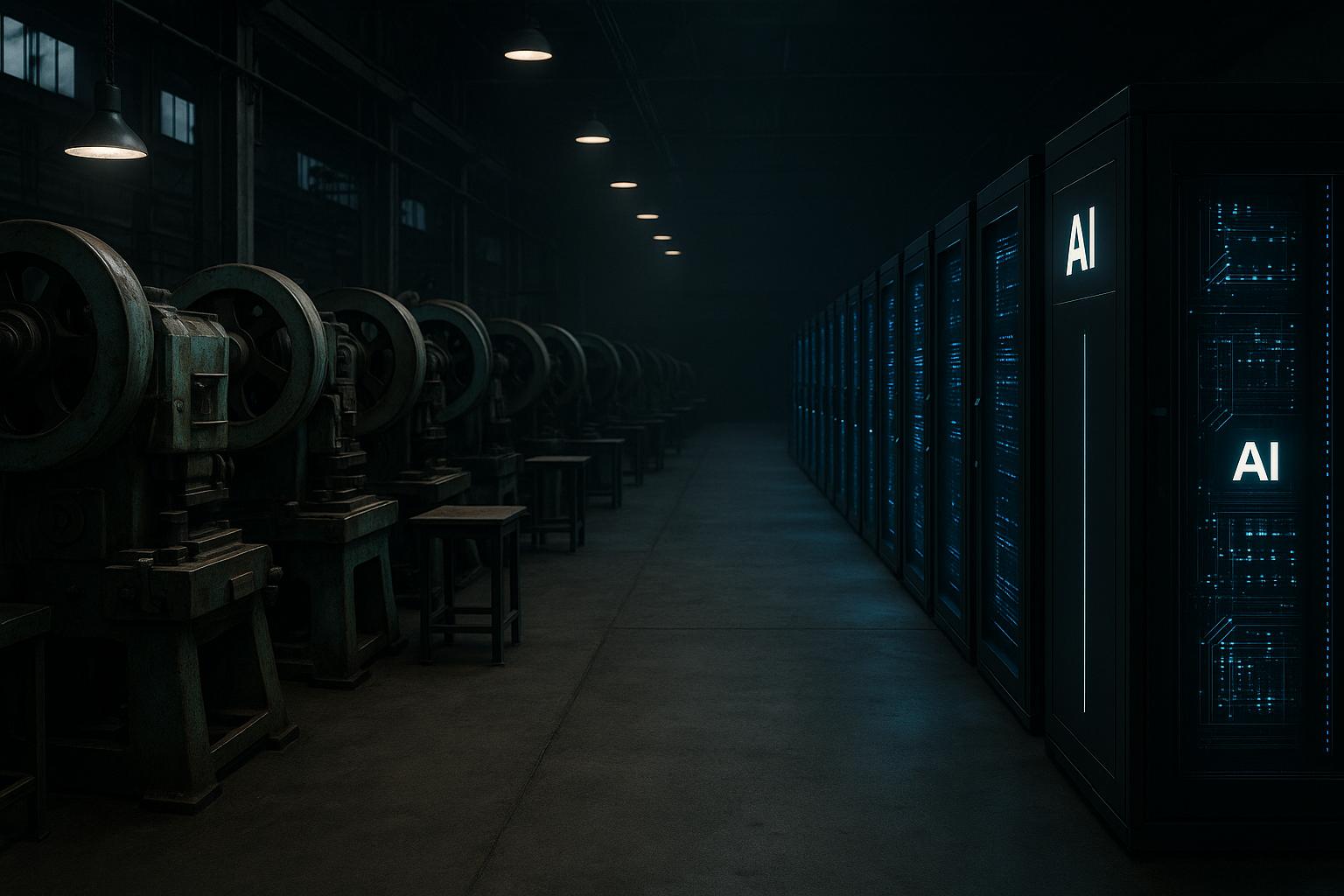
Artificial intelligence and automation are frequently conflated in business and public debate, yet they answer different technological questions and carry distinct operational, economic and regulatory implications. According to the overview by NewsGhana, automation uses machines, software or systems to carry out predefined tasks with minimal human intervention, aiming chiefly at efficiency, consistency and cost reduction; by contrast, AI refers to systems that emulate forms of human intelligence, learning from data, recognising patterns and adapting behaviour over time. [1]
The practical difference is adaptability: automation is deterministic and rule‑bound, executing instructions repeatedly and reliably unless explicitly reprogrammed, while AI is probabilistic and data‑driven, able to make predictions, refine models and handle novel inputs. Industry commentary from EMA and Leapwork underscores this divide, noting that automation suits well‑defined, repeatable processes, whereas AI is best applied to vague, variable or unstructured problems that require learning and inference. [4][5]
Forms of AI in use today are largely "narrow" or domain‑specific: machine learning powers credit scoring, demand forecasting and predictive maintenance; deep learning enables image, speech and text processing; and natural language processing underpins chatbots and document analysis. GeeksforGeeks and AutomationMoon both highlight these categories and stress that general, human‑level AI remains hypothetical, with profound ethical and policy consequences should it ever materialise. [2][3]
Many modern deployments blend the two approaches. An automated logistics chain, for example, may employ AI to forecast demand and optimise routing, then rely on automation to execute scheduling and physical handling. NewsGhana and AutomationMoon describe such hybrid systems as typical in manufacturing and services, where automation handles routine execution while AI reshapes planning and decision‑making. [1][3]
The choice between automation and AI has implications beyond technology procurement. Businesses investing in automation typically focus on process redesign and cost control; organisations pursuing AI must also build data infrastructure, governance frameworks and mechanisms for transparency and accountability. EMA’s analysis warns regulators and firms to address different risks: automation prompts questions about labour displacement, while AI raises concerns about bias, explainability and trust. [4]
Workforce impacts are nuanced rather than binary. NewsGhana and Leapwork argue that both technologies are more likely to reshape job roles than simply eliminate them, shifting the skills premium toward data literacy, critical thinking and human oversight of intelligent systems. Employers that combine automation with AI will increasingly require staff who can manage models, evaluate outputs and intervene when systems encounter edge cases. [1][5]
For policymakers and leaders the imperative is clarity: determine whether a problem needs a rules‑based, deterministic solution or an adaptive, data‑driven one, and align investment, governance and skills development accordingly. Industry guides and technical primers, from GeeksforGeeks to AutomationMoon, offer comparative frameworks and use‑case examples to support those decisions, but they also caution that hybrid implementations demand both technical rigour and ethical safeguards. [2][3][4][5]
##Reference Map:
- [1] (NewsGhana) - Paragraph 1, Paragraph 4, Paragraph 6
- [2] (GeeksforGeeks) - Paragraph 3, Paragraph 7
- [3] (AutomationMoon) - Paragraph 2, Paragraph 4, Paragraph 7
- [4] (EMA) - Paragraph 2, Paragraph 5, Paragraph 7
- [5] (Leapwork) - Paragraph 5, Paragraph 6
Source: Noah Wire Services